
Fast Track to Top Jobs Bootcamp: Building the skills employers say they need most
Across the country, employers are sounding the same alarm: job openings exist, but many applicants arrive unprepared for the expectations of the workplace. While technical training programs are expanding, companies increasingly report that the biggest gaps are not in technical ability—they are in work ethic, communication, reliability, and professionalism.
The Fast Track to Top Jobs Bootcamp was created to address exactly this challenge. Developed as part of the NWI Works workforce strategy, the program focuses first on employability and job readiness skills, then connects participants to industry-specific training and career pathways. The result is a workforce pipeline that meets the needs of employers while preparing residents for sustainable careers.
Why Employers Are Asking for Employability Skills First
Employers frequently report that many entry-level hires struggle with basic workplace expectations such as punctuality, communication with supervisors, teamwork, and accountability. These skills—often called “employability skills”, “soft skills” or “durable skills”—are rarely taught explicitly in school settings.
Recent workforce research highlighted in this Midwest Urban Strategies article has highlighted this disconnect between education and employment. Many students graduate with academic knowledge but have had limited exposure to real workplace expectations, such as professional communication, conflict resolution, or managing workplace feedback. As a result, employers increasingly request training programs that prepare individuals for the behavioral and professional demands of work before technical training begins.
In other words, the modern workforce challenge is not simply about teaching someone how to do a job—it is about preparing them how to show up and succeed in a job.
A Two-Phase Model for Workforce Success
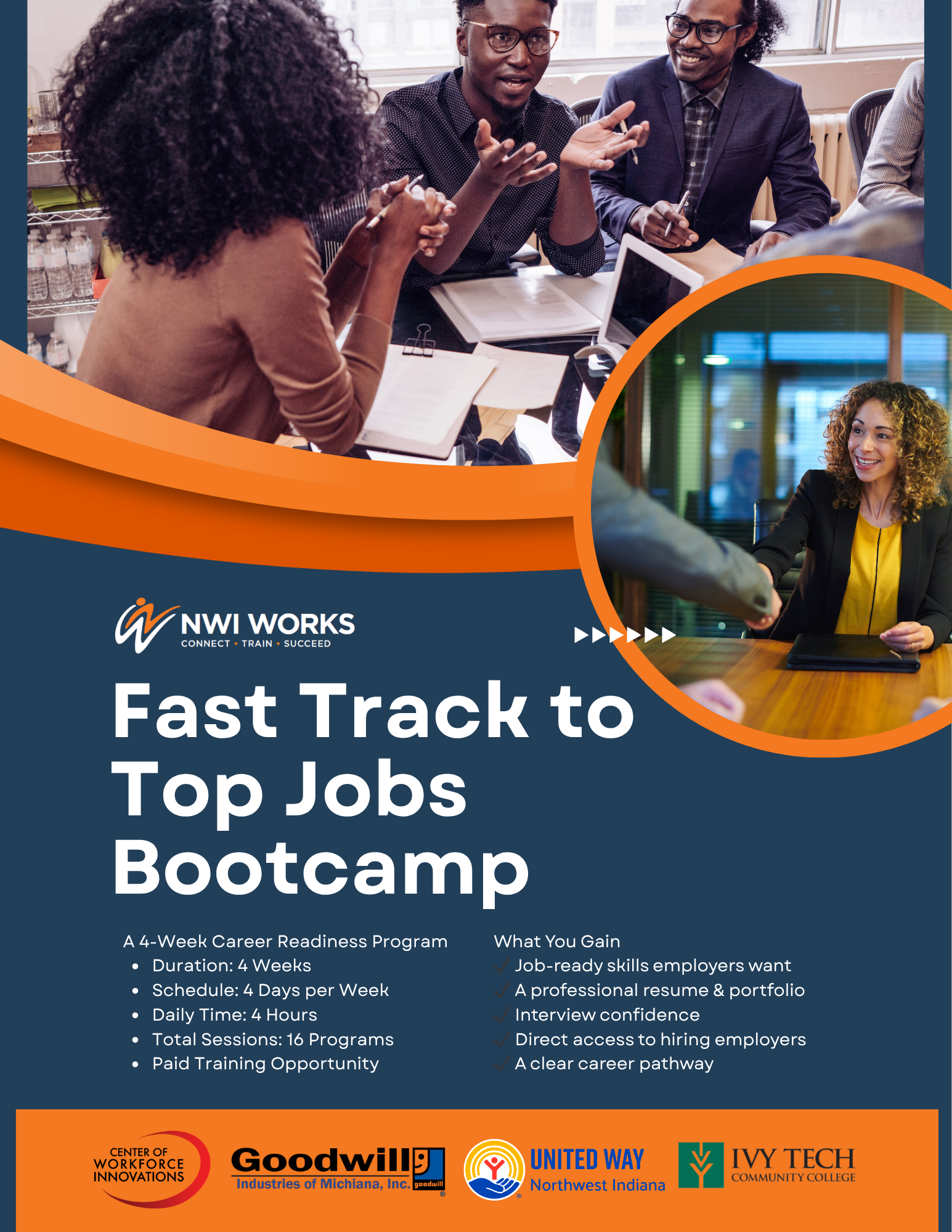
The Fast Track to Top Jobs Bootcamp is designed as a structured pathway that begins with foundational workforce readiness and then progresses into sector-specific employability programs.
The curriculum is developed through a collaboration between The Center of Workforce Innovations (CWI), Goodwill Industries of Michiana, Inc., and Ivy Tech Community College.
Phase 1: Workforce Readiness (4 Weeks)
The first phase focuses on building the foundational skills that employers consistently request. The base program is 4 hours a day, 4 days a week, for 4 weeks. Participants receive a stipend to assist with childcare, transportation, or living expenses during the training.
Participants develop:
Work ethic, reliability, and punctuality
Communication and active listening
Teamwork and collaboration
Professional behavior and customer service
Time management and organization
Problem-solving and critical thinking
Workplace safety and compliance basics
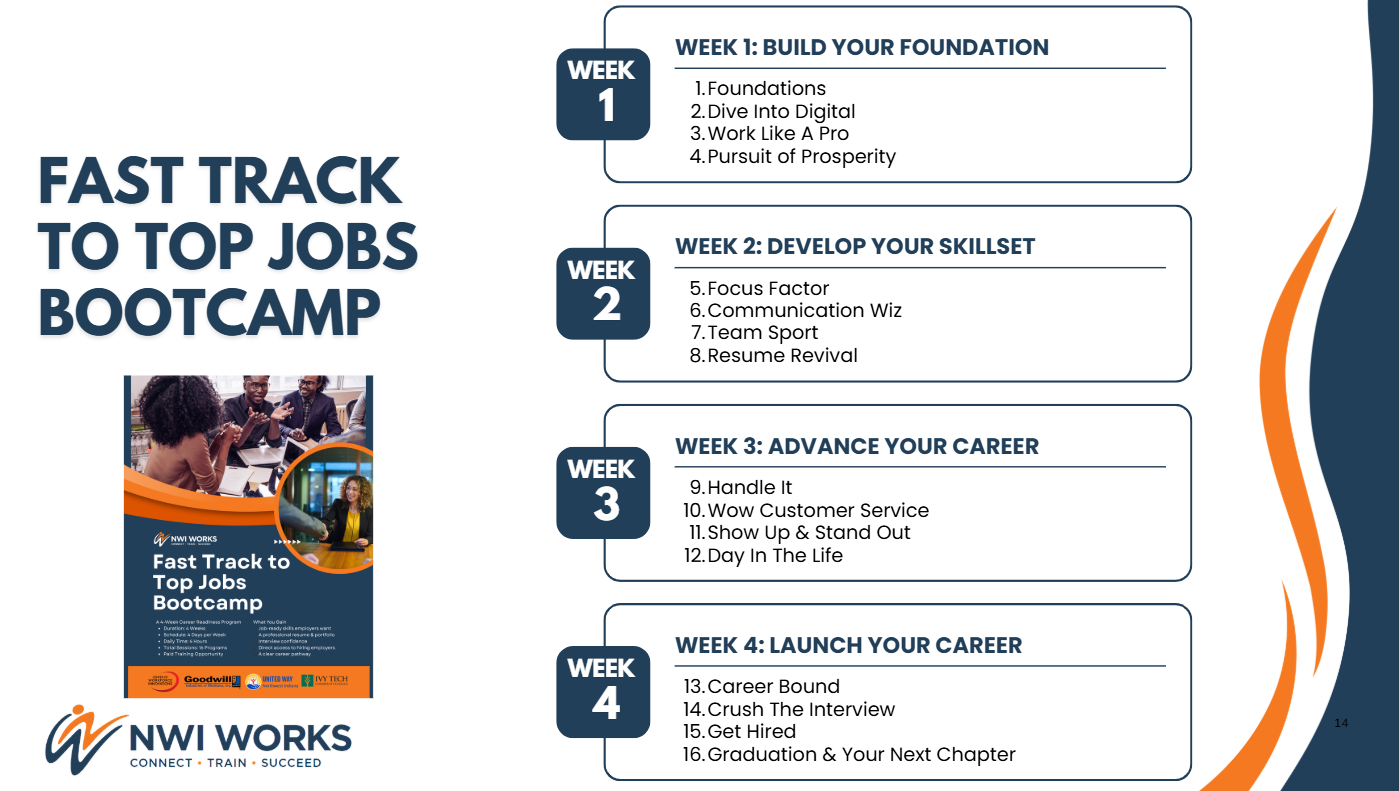
The goal is to help individuals develop the habits and mindset necessary to succeed in any workplace. By the end of this phase, participants complete a work-readiness portfolio, an employability skills completion certificate, and a possible employer shadowing experience, demonstrating their preparedness for employment.
This phase also includes simulated workplace scenarios, role-plays, and real-world employer interactions to ensure that participants gain practical experience applying these skills.
Phase 2: Employability Programs
Once foundational skills are established, participants move into industry-specific training aligned with regional job demand.
Training pathways include:
Advanced manufacturing
Logistics and transportation
Construction and skilled trades
IT and digital services
Professional and administrative services
Hospitality and food service
Participants gain technical exposure, job-search skills, and work-based learning experiences, such as mock interviews, apprenticeships, or employer-sponsored internships.
By the end of the program, graduates have:
A professional resume and portfolio
Industry-aligned credentials
Real employer connections
Interview preparation and job search skills
This approach dramatically improves time-to-employment and job retention, two of the most important outcomes for workforce programs.
Supporting Employers’ #1 Workforce Request
Employers consistently request workforce programs that produce “job-ready” candidates, not just trained candidates.
The Fast Track to Top Jobs Bootcamp responds directly to that request by:
Creating a reliable pipeline of work-ready employees
Reducing onboarding and training time for employers
Improving employee retention through workplace readiness
Aligning training with regional industry sectors
As workforce systems evolve, programs like this are becoming essential. Modern workforce development is shifting toward employer-informed, demand-driven training models, in which businesses help shape training programs to meet real labor-market needs.
This means employers are no longer just recipients of talent—they are partners in developing it.
Preparing People for Careers, Not Just Jobs

The Fast Track to Top Jobs Bootcamp is about more than job placement. It is about preparing individuals for long-term career success.
By combining soft-skill development, industry training, and employer engagement, the program helps participants:
Enter the workforce with confidence
Build a professional identity
Navigate career advancement opportunities
Adapt to evolving workplace expectations
For communities, the impact is equally important. Workforce programs that focus on readiness and retention strengthen regional economies by connecting residents to family-sustaining careers in high-demand industries.
A New Model for Workforce Readiness
The future of workforce development will increasingly depend on programs that combine behavioral readiness, technical training, and employer partnerships.
The Fast Track to Top Jobs Bootcamp represents a new model—one that recognizes a simple truth employers have been emphasizing for years:
Technical skills can be taught.
But employability skills must be developed first.
By investing in these foundational capabilities, communities can build stronger talent pipelines, help employers grow, and ensure that more individuals are prepared not just to get a job—but to thrive in one.
To learn more about participating in this program as a participant or employer, please contact us today!
Upcoming sessions:
Gary, IN
Michigan City, IN